Ahren Innovation Capital is a deep technology and deep science investment firm founded in Cambridge in 2017 by nine individuals who have collectively built more than $100 billion of company value.
Some of those have brought blockbuster drugs to market like Sir Greg Winter who won the Nobel Prize in Chemistry for his pioneering work on technologies for making humanised antibodies such as Keytruda, the world’s bestselling drug in 2025. Others now hold leadership positions in some of the top AI labs in the world such as Google DeepMind.
Since inception, the firm has been investing directly in physical AI and was the first institutional investor in Mentee, a company that was acquired by Mobileye earlier this year for $900 million – believed to be the largest outcome in the humanoid robotics category to date outside of China1.
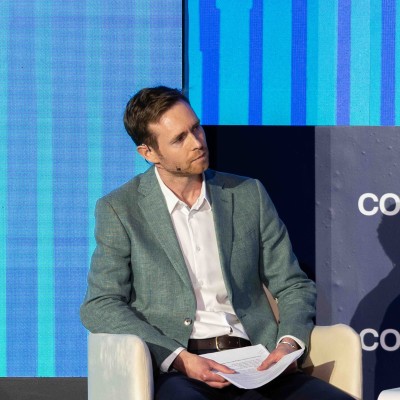
“The team collectively has been working on robotics for decades so it was always clear to us that this was an important area,” says Oliver Hedaux, who leads technology investments at Ahren.
Oliver is a founding member of the investment team and sat on the board at Mentee from the first investment through to exit.
“When we first invested in Mentee there were sub 10 credible humanoid players in the world. I think there was a belief that the challenge was just too difficult but we firmly believed that this was the right time from a technology perspective and the right team to execute on it. Fast forward to today and there are 200 plus humanoid players in the world and investors have really woken up to the extraordinary opportunity.”
Oliver says this example demonstrates Ahren’s capacity to spot an opportunity early, invest, and deliver strong returns for investors and shareholders.
“We’re a multi-stage firm, but we’re uniquely set up to recognise important breakthroughs in science and technology early and access the world’s best teams turning those breakthroughs into products. By leveraging a strong partnership between our investors and our Science Partners, we understood early before generalist investors that large language models would be important. We also understood early that ways to use data differently, such as simulation and world models, would be important for robotics. And that’s what I think is starting to prove out in our track record.”
The robotics portfolio
Ahren invests in four robotics companies today, including Mentee.
Its first investment in robotics was in Micropsi Industries which provides a vision system for industrial robots, enabling them to carry out fine-grained assembly and materials handling tasks. For example, picking up a cable in a varying position and inserting it into a plug during electric vehicle manufacturing or data centre maintenance. Ahren co-led a $30 million Series B in the company back in 2020, alongside a group of global investors.
Ambi Robotics builds parcel-sorting robots for warehouses, selling to some of the world’s biggest brands and third-party logistics providers. The company’s technology grew out of research from Professor Ken Goldberg’s lab at Berkeley, using synthetic 3D data to train robots capable of reliably picking parcels of wildly varying shapes, sizes and textures.
Aerones stands apart from the rest of the portfolio. The Latvian company builds robots that crawl up wind turbines to inspect and repair their blades, a job historically carried out manually by rope access technicians. Aerones now holds contracts with major wind turbine manufacturers and operators globally, running as a tech-enabled services business rather than a pure technology play.
“The belief of the firm is that the future will be cross domain,” Oliver says. “To be an expert in robotics, you must also be an expert in computer vision. We like teams whose product only becomes possible when several scientific and engineering disciplines mature at once. Apply that lens to physical industries such as manufacturing or energy and the generational opportunity to build transformational businesses becomes clear. That’s how we think about robotics as a firm.”
Spotting opportunities
Ahren’s edge, Oliver says, comes down to its network. A “unique assembly of highly original thinkers who are at the top of their field” across a broad spread of technical and scientific domains.
“That provides a really privileged opportunity, as an investment team member, to hear perspectives on who the most exciting researchers are in one field, or what promising technology is ripe for commercialisation. But then, importantly, being able to see across those domains.”
As well as regular catch ups, the team meets as a full group at least once a quarter to track the people and technologies it considers most promising, then decides collectively how to act on them.
Investments also tend to compound. Ahren’s investment in AI21 Labs, an Israeli Natural Language Processing (NLP) company, gave the firm a foothold in the Israeli ecosystem which is how it first heard about Mentee being formed.
“Our investment in AI21 built trusted relationships that ultimately meant the Mentee team chose to partner with us, and we’re deeply grateful for that.”
How to get on Ahren’s radar
The new currency in robotics, Oliver says, is demos.
“We’re in a world now of increasingly impressive demos coming out on social media which has become the new currency of robotics companies working at the cutting edge. It’s the same role cumulative miles once played for self-driving.”
He points to Generalist as a recent example that caught Ahren’s attention, one of the first companies to show that in-context learning is possible in robotics. This is where a robot is shown a single demonstration of a task and can then perform it.
“We find demos exciting, of course, but what we really need to believe is that a company will turn capabilities into deployments at scale that economically solve a customer’s job to be done. Robotics is a systems engineering challenge and the teams that will ultimately be successful are those that overcome hurdles in reliability, cost, integration, safety, servicing and so on. We screen for this ability.”
The overlooked opportunities
Oliver flags service robotics as one of the most overlooked corners of the market. Think cleaning, security and facilities management. Categories with little glamour but real, provable economics.
“We really like these underserved areas,” says Oliver. “There are some very promising businesses in Europe, several of those in Switzerland, Zurich. Companies like Loki Robotics doing cleaning or Laelaps, which is automating security for large real estate facilities.”
Ahren is also watching advances in video generation, and how they can reduce the volume of robot data needed to perform complex manipulation tasks – what some in the industry call world action models.
“Video generation models are increasingly showing the ability to learn physical common sense such as what happens when objects collide. A robot’s camera observations can be used as an input to the video model which then outputs one or several clips of the task being completed. The robot is effectively dreaming up all the possible next actions that it could take and then picking the optimal one for the task.”
Oliver points to Wayve, a Cambridge company recently valued at over $8 billion, as one of the first to apply this approach in a self-driving context and says it’s now crossing over into manipulation through companies like Mimic Robotics in Zurich and Rhoda in the US.
Europe’s capital gap
Asked whether Europe is falling behind the US and China in physical AI, Oliver is candid about where the real gap lies.
“There’s no shortage of ambitious entrepreneurial scientists in Europe and indeed many of America’s unicorns including Anthropic, OpenAI and Cerebras have European founders or co-founders. But there’s still a lack of capital willing to support these very high-end, and in some cases, capital-intensive companies all the way in Europe. This means our strongest operators often relocate or get acquired abroad, and it’s those operators with scaling experience who we really need to keep.”
On China, his read is that the edge is industrial rather than scientific. “I think that’s something which we really challenge entrepreneurs to think about as they think about their hardware strategies. How can you leverage that to bring the cost of your robot down, to scale more efficiently as a company. There’s a lot of learning we can take from China’s manufacturing ecosystem.”
Talent, hardware lessons and impressive demos are all learnable. Capital is not and that, for Oliver, is Europe’s real test.
If Europe’s talent and ambition in robotics are going to produce the next Mentee, it’s investors who need to step up and back them at the scale the technology demands.
1 Based on market research. Hyundai paid $880M for a majority stake in Boston Dynamics in 2021 (source).