After selling data analytics startup Silk to Palantir in 2016, Salar al Khafaji could have built another software company. It’s certainly his beat after all, having started coding at the age of nine. Instead, the entrepreneur turned his attention to one of the world’s oldest and least automated industries: construction.
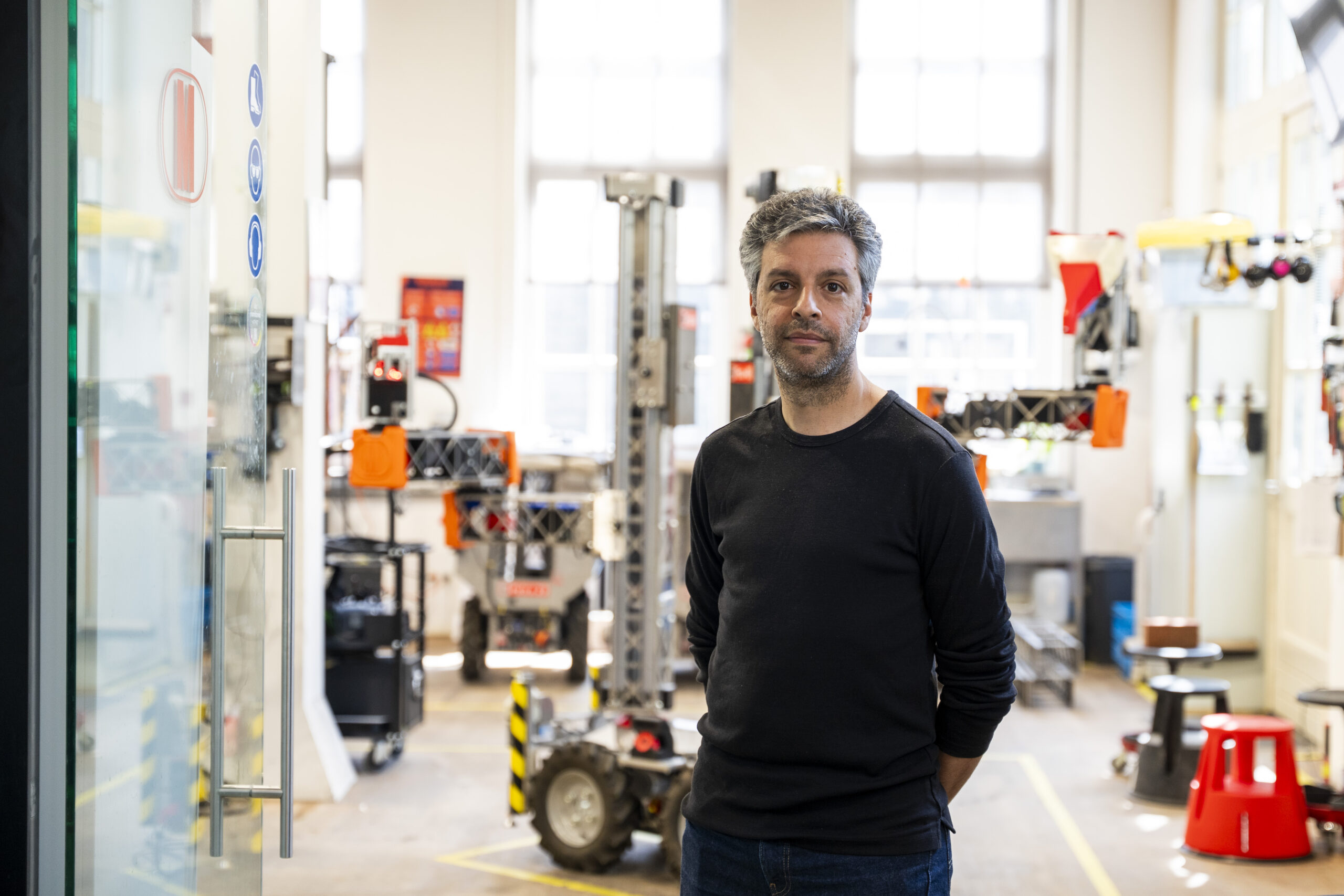
Today, Salar is founder and CEO of Amsterdam-based Monumental, which deploys fleets of autonomous bricklaying robots on construction sites across Europe.
The robots have helped build more than 100 homes in the Netherlands and the UK, including schools, hotels and community buildings. Having recently raised $32 million in a Series B funding round, Monumental is now preparing to enter the US.
In this exclusive interview, Salar explains why construction has lagged behind other industries on automation, why Monumental chose to sell walls instead of robots, and how autonomous bricklaying could help tackle the industry’s deepening labour crisis.
IZON: After building a successful software company, why turn your attention to construction robotics?
Salar al Khafaji: I’ve been obsessed with software since I was nine years old. I studied physics before starting my first company, Silk, which we sold to Palantir in 2016. While I was there I worked with manufacturers, aerospace companies and industrial businesses that were all investing heavily in digital automation. What struck me was that construction wasn’t.
I also became obsessed with the aesthetics of buildings. You walk through somewhere like Amsterdam or an old English city and you see incredible craftsmanship from hundreds of years ago. Then you look at much of what we’re building today and, in many cases, it’s worse. Construction hasn’t really become more productive in the last century. I genuinely believe robotics can have a bigger impact here than almost anywhere else because the industry has barely benefited from automation.
Why has construction proved so difficult to automate compared to say transport and self-driving cars?
People underestimate how difficult construction actually is. We need millimetre accuracy. A self-driving car can tolerate being a centimetre off position on a road. If you’re building a house and you’re one centimetre out around a window frame, you’ve got a serious problem. The technology simply wasn’t ready until recently. Advances in computer vision, AI, mapping and compute have made it possible to understand construction sites in real time with the level of precision we need.
There are very few bricklaying robotics companies globally. What do you think Monumental does differently?
I can think of maybe two or three serious companies worldwide. I actually think our business model is one of the biggest differentiators. People assume contractors want to buy technology. They don’t. What they do buy every single day is subcontracted work. Construction is a series of sub-contractors all the way down. Every specialist trade is hired to deliver an outcome, not a piece of technology. Bricklayers are paid per brick, per thousand bricks or per square metre. Customers don’t care whether that wall is built by humans, robots or magic as long as they get the wall they paid for. So our approach has been to fit into that existing business model rather than trying to change it. We’re not selling a robot, we’re selling them a wall. If our robots fail, that’s our problem. In the early days we told customers we’d simply send human masons to finish the project, even if it destroyed our margins. That builds trust because we’re taking on the technology risk, not asking customers to.

That seems like a very conservative approach for a robotics company.
It is, and intentionally so. We’re doing something incredibly revolutionary from a technology perspective but from the customer’s perspective we’re actually very conservative. We don’t ask them to use special bricks, special mortar or new building methods. We use the same materials the industry has used for decades. As soon as you introduce new materials you create regulatory hurdles, engineering challenges and customer hesitation. The easier we make it to say yes, the faster the industry adopts robotics.
If you’re not asking construction companies to change how they work, what problem is Monumental solving?
The biggest problem we’re solving today is the labour shortage. The shortage is so severe that every layer of the industry is struggling. Main contractors can’t find subcontractors, and subcontractors can’t find enough people to do the work. In the UK alone there’s a shortage of around 20,000 bricklayers needed to build the homes the country requires over the coming years. And it’s only getting worse because of demographics. Almost no one wants to enter the industry anymore, while many experienced bricklayers retire early because it’s such physically demanding work. In many European countries, people leave construction around the age of 55 rather than the typical retirement age because their bodies simply can’t keep going.
Thinking about the walls themselves. Is it just straight walls the robots build or can they take on more complex tasks?
We’ve already demonstrated curved walls, custom colour patterns and complex masonry details that have disappeared over the years because they’re too expensive to build by hand. For a human bricklayer those kinds of decorative walls dramatically increase labour costs because they slow everything down. Our robots don’t really care whether the wall is straight or curved. My hope is that robotics brings back beautiful architecture because those kinds of details become affordable again.
What’s the fastest your robots have built a property and how much does speed matter to your clients?
Speed doesn’t matter as much as people think. Our robots are small and compact, and we deploy multiple robots on a site. Because our robots can work around the clock, we free up the few skilled masons a contractor has to focus on the projects that are truly time-constrained. At the end of last year, we ran our first non-stop build for 36 hours straight to complete the brickwork on a transformer substation. Today, a single robot does about half to two-thirds of what a mason does on average, although we’ve seen them hit two to three times human productivity on peak days. If you need to build twice as fast, we don’t need one robot to work twice as hard. We just deploy twice as many robots.
Construction is an enormous industry. How do you think about the Total Addressable Market?
Construction is one of the largest industries in the world, but it’s also incredibly fragmented. Nobody owns a huge market share because it’s built around specialist subcontractors. If you look purely at bricklaying, the Netherlands lays roughly one billion bricks every year, the UK lays around 2 billion clay bricks, and the US lays substantially more.
But bricklaying is only the beginning. The next market for us is blockwork, meaning concrete blocks, limestone blocks and concrete masonry units. Every office building, parking garage and hotel is built using those materials. In the US alone that’s roughly 50 to 60 billion blocks laid every year. So our initial market is already enormous before we even think about expanding into other construction tasks.
How do the economics work today?
We’re not profitable yet, but we’ve already shown that individual construction sites can be profitable and that’s the milestone our investors wanted to see. We’ve demonstrated multiple projects where the robots generated positive economics while delivering finished walls on real construction sites. Once you prove that, the question becomes whether you can scale it across hundreds or thousands of projects.
You’ve just raised another $32 million. What does the next chapter look like?
The immediate focus is expanding into the US. We’re targeting our first pilot projects before the end of the year, initially in states like Texas and Virginia where we’re already seeing strong inbound demand. Construction is one of the largest industries in the world but it’s constrained by labour shortages almost everywhere. We think robotics can become another specialist subcontractor that simply plugs into how construction already works.
This interview has been edited for clarity and length.