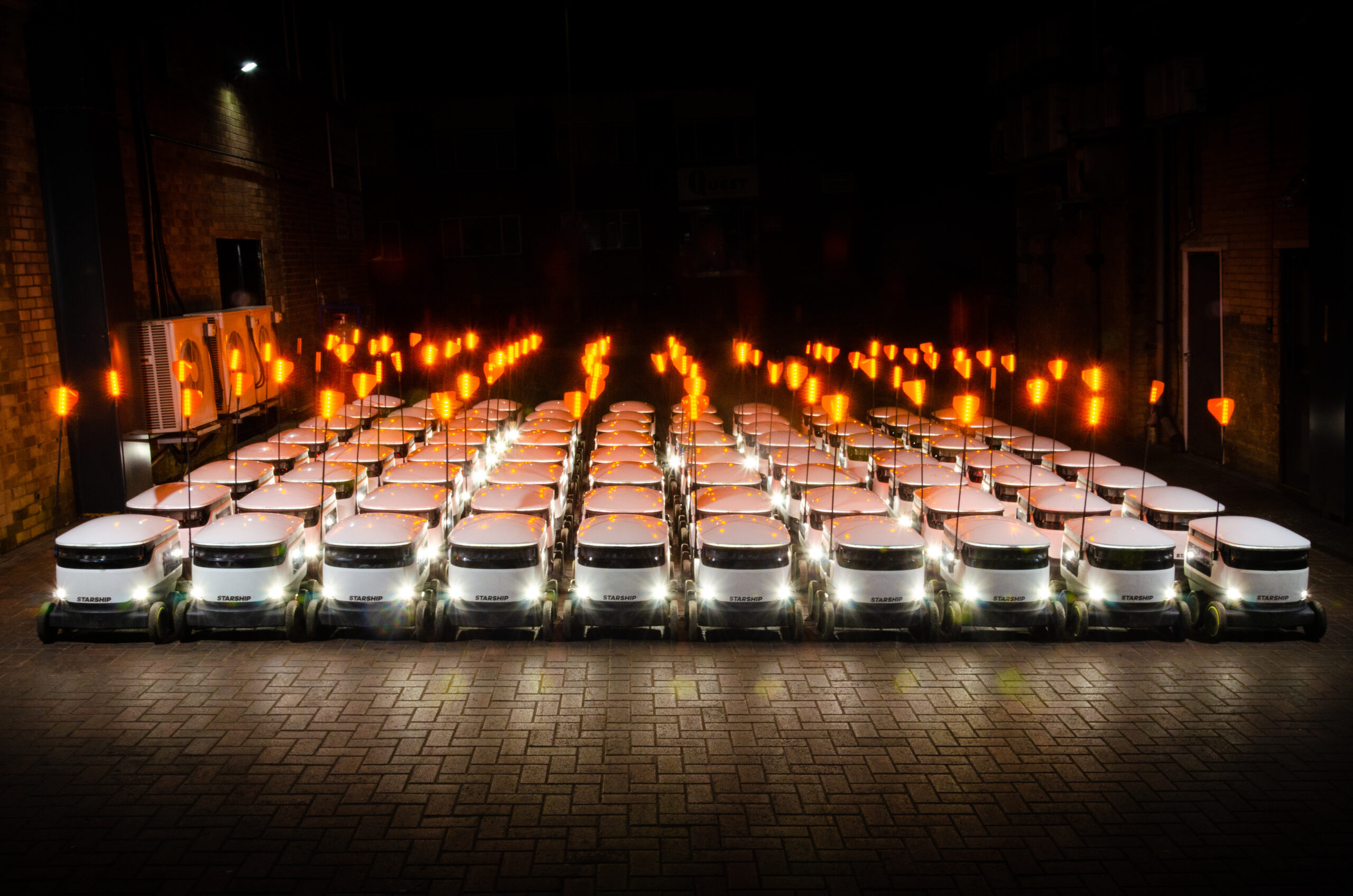
Starship Technologies, the world’s largest sidewalk delivery robot operator, says regulatory uncertainty has pushed the UK down its list of priorities, despite the country once being its biggest global market.
Founded in Estonia 12 years ago, the physical AI company has just surpassed 11 million deliveries, operates in more than 300 locations worldwide and has raised more than $280 million.
For years, the UK was Starship’s star market. Its first commercial operations began here, and its robots now operate across more than six cities, including Milton Keynes, Leeds, Sheffield, Barnsley, Sunderland and Cambridge.
“The UK is like our second home,” Lisa Johnson, Starship’s Global Vice President of Public Affairs, tells IZON in an interview.
“It used to be our biggest hub globally and the most sophisticated operation anywhere in the world. It’s not the case anymore, and it is because of regulation. We’ve not been able to move as fast as we would have liked to.”
It has taken 12 years for Starship to deploy 300 robots on UK streets. Finland, meanwhile, has deployed more than 1,000 robots after just a six-month pilot.
“The Finns ran a pilot, decided they liked it, created a national baseline safety framework and now there’s over 1,000 robots operating as far north as Lapland in Finland, serving their biggest retailer in the country,” says Johnson.
“There’s big potential in the UK and we’re still very committed to it, but you can’t get around the fact that it has dropped down the priority for us purely because of that lack of regulatory certainty and clarity.”
A regulatory “grey area”
At present, there is no dedicated national framework governing the use of delivery robots in the UK.
UK roads and pavements are governed by the Highways Act 1835, but the legislation is not well suited to emerging technologies such as delivery robots. The Act prohibits “carriages” from operating on pavements, but does not clearly define whether autonomous delivery devices fall within that category. As a result, the legal status of delivery robots remains unclear. In practice, trials have been able to proceed where delivery players such as Starship have permission from councils.
The lack of legislation extends beyond delivery robots to other emerging technologies, including micromobility devices such as e-scooters.
The UK government has said it will introduce a new Low-Speed Zero Emission Vehicle category to regulate delivery robots and micromobility vehicles when parliamentary time allows. Micromobility players have been waiting for this legislation for six years.
“The problem is that robots never make it to the top of the parliamentary timetable and until that happens it will be a grey area,” Johnson says.
“We need clarity, consistency and certainty. Our board is saying, “Well, what is the potential for scale?” We know we can do it. Local authorities and our customers want much more certainty, and while we can scale with the model we have now, we need greater clarity for the future.”
Government looks to sandbox pavement robots
Starship’s concerns come as the government signals that it wants to make it easier for companies to test technologies such as its robots.
In his Growth Speech on Monday, Chancellor John Healey said the government aims to have new “sandboxing powers” in place next year, allowing businesses and innovators to safely test frontier technologies that are currently constrained by regulation.
He specifically cited “pavement robots” alongside drones and medical treatments as examples of technologies that could benefit from the new approach.
Johnson at Starship welcomed the reference, saying the government’s focus on ensuring regulation supports innovation and growth was a positive signal for the sector.
“Listening to the Chancellor’s speech yesterday, the focus was on ensuring regulation supports innovation and growth – pavement delivery robots got a cheeky name check, so the use case has landed now with Ministers and government departments, which is great news because we know delivery demand is not decreasing. Retailers and local authorities need solutions; we can provide that.”
The announcement could offer a route out of the regulatory uncertainty that Starship says is holding back its UK expansion.
The company says it wants to deploy more than 10,000 robots in the UK and could establish a manufacturing site here if the government provides greater clarity over the rules.
But even if the government provides regulatory clarity, another question remains: will the public accept more robots on its pavements?
Accessibility concerns simmer
UK charity Living Streets, which campaigns for better walking environments, has launched a petition called Pavement Overload, urging members of the public to write to their local MP to request a ban on delivery robots. As of last week, IZON learned that the petition had garnered around 2,000 signatures.
“Pavement Overload was launched after concerns robots were popping up on our pavements without consultation with residents, disability groups, or without any explicit laws governing their use,” Tanya Braun, Director of External Affairs at Living Streets, told IZON.
“When technologies are tested and deployed without public engagement, private profit is being prioritised over people.”
Living Streets believes that delivery robots are making streets harder to navigate, especially for disabled people, older people and those living with sight loss.
“Our pavements are already littered with obstacles, forcing people off the safety of the footway and putting them off using their local streets altogether. The way things are with people already fighting for space, we don’t believe robots should be permitted on our pavements.”
Another petition on the Organise platform has had 6,399 signatures at the time of writing.
When I questioned Lisa Johnson about the Pavement Overload campaign, she said: They [Living Streets] don’t want to meet. They don’t want to talk about it. They don’t want to make the robots better. They just don’t want the robots to exist and so I don’t know how you have a conversation around that really. But we do so much work on accessibility.”
Johnson explains that Starship has been working with several disability charities, including Leonard Cheshire, RNIB and Guide Dogs UK, to help ensure the robots behave sensitively.
“RNIB said that the flag on our robot didn’t work for people with low vision because it used to be pale yellow, so now it’s bright orange with LEDs that pulse in the middle of it because that’s what they told us would be better.
“The robot recognises mobility devices, so if we’re on a narrow path and meet a wheelchair or mobility device, we’ve got plans for that. The latest update in the app is for people who can’t see the robot. It now makes a noise to say their delivery has arrived.”
“Up to 25% of our regular customers in the UK say they’ve got a disability or live with someone else who has a disability and we want to ensure we serve everyone.”
Accessibility matters to partners too
That focus on inclusivity matters not just to Starship but to the businesses that use its robots. The company relies on commercial partners to provide the goods being delivered, meaning accessibility and public safety are also considerations for the businesses adopting the technology.
IZON spoke with Zornitsa Chugreeva, Senior Global Innovation Director at Just Eat, which launched a pilot in Sunderland earlier this year.
“We have chosen to trial autonomous delivery in the UK based on growing customer demand for orders to be delivered conveniently and quickly.
“We offer a diverse range of cuisines for customers to choose from, including burgers, British and bubble tea, all delivered autonomously in minutes.”
Sunderland was selected as Just Eat’s first UK city for the trial because it is home to the company’s customer service team. Since then, the trial has expanded, with Just Eat now operating across Sunderland, Milton Keynes and Barnsley.
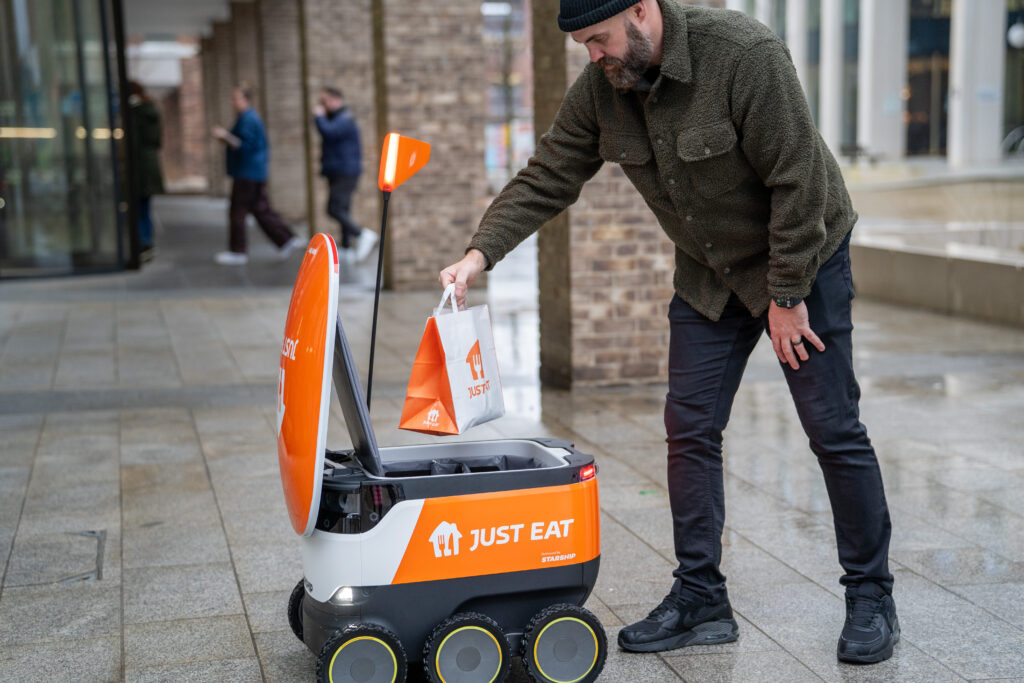
“As the technology evolves we will continue to prioritise working with trusted and responsible partners such as Starship. Our partners are independently responsible for operating autonomous delivery robots and so it’s important to us that they prioritise public safety and inclusive design.”
A report estimates that the autonomous delivery robot market will be worth roughly $3.2 billion by 2030.
For the UK, that represents a significant opportunity but one that depends on getting the balance right. If delivery robots can be deployed safely, sustainably and responsibly, there is scope for the technology to become a meaningful part of the country’s logistics infrastructure.
The longer regulation remains unresolved, however, the harder it will be for companies like Starship to invest and scale with confidence.
For a market that was once Starship’s global flagship, the question now is whether the UK can provide the clarity needed with this Sandbox to turn that potential into reality.